‘We can’t lose sight of the opportunity.’ How Regence uses AI to make care more affordable and accessible
Artificial intelligence has very quickly progressed from curiosity to life-changing technology. At Regence, our work in AI started a decade ago and has always been guided by our mission of improving the healthcare experience for our members.
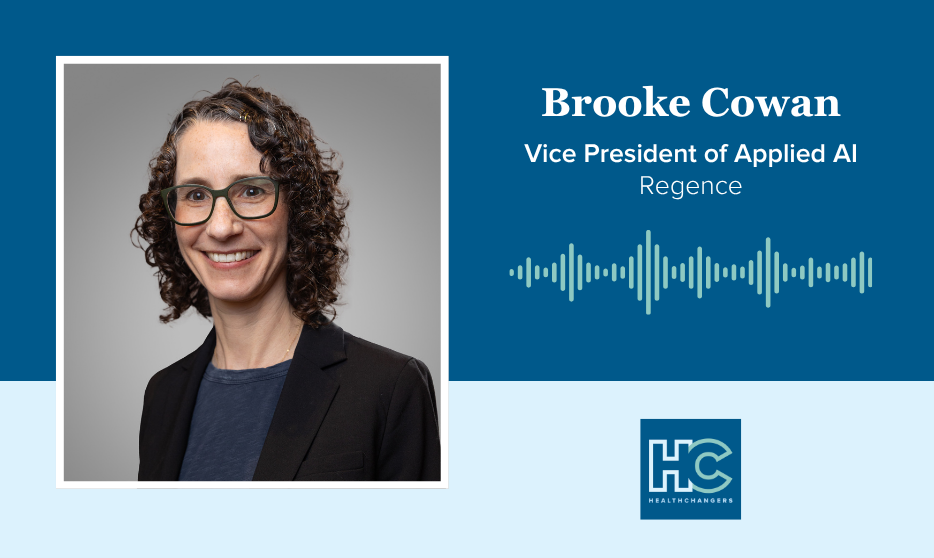
On this episode of Health Changers, host Ashley Bach speaks with Brooke Cowan, vice president of applied AI at Regence. They talk about her career working in healthcare innovation and how Regence is using AI to make healthcare better for the employers and families we serve.
AB: Brooke, before we talk about Regence’s work in AI, I wanted to talk about your career path. You have been working in AI for a long time, well before it hit the national consciousness. What got you started in the industry?
BC: What drew me into the field was language. I was a graduate student in computer science studying natural language processing, or NLP, which is the field that’s focused on helping computers understand human language. Really early on, when I was working on my master’s degree, I spent a lot of time trying to write rules that would capture grammatical structure and meaning. And what I learned was that human communication is constantly breaking those rules, because the reality is that language is incredibly contextual and nuanced, and tends to defy any rules that you write down. And that realization ultimately took me toward machine learning, which is a mechanism that allows systems to learn from examples and recognize patterns instead of humans trying to write down the rules.
As a grad student, I saw that the technology really needed to evolve to learn the language of human beings. Rules just don’t cut it. You need more powerful models and more powerful approaches. And now we have an opportunity where the technology has evolved to the point where AI is creating opportunities for healthcare to understand humans, rather than the other way around.
AB: It feels like AI is inescapable right now, in the headlines and elsewhere. What is your overall reaction to this, given your longtime work in the field?
BC: Honestly, surprised, by the speed and the direction that the field has gone in. If you’d asked me back when I was a grad student at MIT whether in my lifetime we’d have systems that could do the things that the AI systems can do today – like hold sophisticated conversations and generate content, write software and reason through complex problems – I don’t think I would have predicted that the systems would have evolved to the point that they have.
At the same time, one of the advantages that I have being part of building these systems is that you get to see what’s going on under the hood. It’s true these systems are incredibly capable, but they’re not magic. They require a lot of thoughtful design, rigorous evaluation, continuous testing, as well as really strong governance.
I’m amazed by how far the technology has come, but I am equally focused on the responsibility that comes with deploying it well, and that’s one reason why at Regence we’ve spent so much time building out our governance frameworks and making sure we’re evaluating our systems and following responsible AI practices.
We want to make sure that we’re not just building some impressive technology, but we’re building technology that really genuinely helps people. That’s what is super exciting about what’s going on in AI in healthcare right now. It’s not really about AI for AI’s sake. It’s about using these capabilities to make healthcare easier to navigate for our members, to make it more personal and to make it more accessible for the people that we serve.
AB: Can you elaborate on what guides Regence’s work in AI?
BC: What guides our work is our mission. When we’re evaluating new AI opportunities, we ask ourselves three important questions: One, will this make it easier for our members to navigate the healthcare experience? Two, is it going to lead to better health outcomes? And three, will it make it more affordable for the people who rely on the healthcare system? And if we can’t really answer those questions, then we probably shouldn’t be working on that.
We also believe really strongly that AI should amplify human expertise and not replace it. So that’s another driving force when we think about the application of AI. It’s not really about removing people from the process. It’s really about helping skilled people have a greater impact. So you think about a Regence care team or a customer service professional or clinician; these are all individuals with incredible expertise. That’s very valuable, but everyone’s time is finite, and AI can help us reduce the administrative burden. It can help surface relevant information faster, and it can help streamline workflows so people can spend more time helping our members.
AB: What are some examples of Regence using AI to help our members?
BC: One of the things that we’ve been talking about a lot is how healthcare can be really difficult to navigate. When people have a health concern, they’re not waking up in the morning really excited to understand benefits and claims and coverage rules or terminology. They want answers when they need them, and historically in healthcare getting those answers has meant doing a lot of work, like searching websites and reading documents, understanding a lot of complicated terminology and making phone calls. What we have with AI is really a huge opportunity to make those interactions much more natural.
We have an AI-powered assistant that is going to help our members get answers to their questions much more quickly and easily. This is actually a tool that we rolled out and tested with our Regence employees, and are slowly rolling out to other members. And the way this works is, this tool allows people to ask questions in their own words and have conversations that feel really intuitive, and that’s really important because people don’t think in healthcare terminology; they think in terms of their lives, and they’re asking questions like, “How much is this going to cost? And is this covered? And what should I do next?” AI can really help bridge that gap.
Another example: we’re also applying AI to support our clinical and operational teams. One area we’re particularly excited about is helping clinicians and reviewers work through vast amounts of clinical documentation and information efficiently. In healthcare, there are certain kinds of services, procedures, treatments that require a clinical review before coverage can be approved. In the industry, this is called prior authorization. And the goal is to ensure that care is appropriate and evidence based. But those reviews often involve working through really large amounts of medical documentation and notes, clinical guidelines, and other supporting information. AI can help summarize that information and surface the relevant information to the clinicians. So that it can help reduce their administrative burden, and our reviewers, our clinicians, can spend more of their time applying their expertise and their clinical judgment to a case.
AB: What is an example where Regence is using AI to make healthcare more affordable?
BC: Affordability is one of the biggest concerns facing people today, and it’s an area where AI can have a very meaningful impact. For example, every day at Regence there are huge numbers of claims and bills and transactions occurring across the system, and hidden among all those transactions can be situations where costs may be unusually high, or there may be opportunities to reduce waste or other unnecessary spending, and AI is particularly good at helping identify these kinds of anomalies and patterns at a much greater scale.
At Regence, we’ve developed an AI-powered capability that helps identify medication charges that may warrant additional review by a human. If you tried to look for those opportunities one at a time across hundreds of thousands of transactions, that would be really hard. But with AI, we can surface these charges to our teams and then help our team members focus their expertise on the exact places where they’re most likely to have an impact. Using AI to identify these cost-saving opportunities in claims has already saved our members millions of dollars in the aggregate over the decade-plus that Regence has been investing in AI.
AB: AI is a real flashpoint in the national conversation. Everyone seems to have a strong opinion, whether it be data centers or privacy concerns or the billions of dollars that the large AI companies are spending. What is your take on the high volume and intensity of the discourse around AI?
BC: One of the reasons the conversation is so intense is that people intuitively recognize that there’s something really important going on right now. I’ve spent most of my career in and around AI, and I can honestly say I never expected to see some of the capabilities we’re seeing today. Many of the things that seemed like science fiction not too long ago are becoming a reality, so I understand both the excitement and the concern, which is why I think going back to responsible deployment is so important. We really have to understand the strengths and limitations of these technologies, and we have to be thoughtful about how we use them; but also, I think it’s really important that we not lose sight of the opportunity.