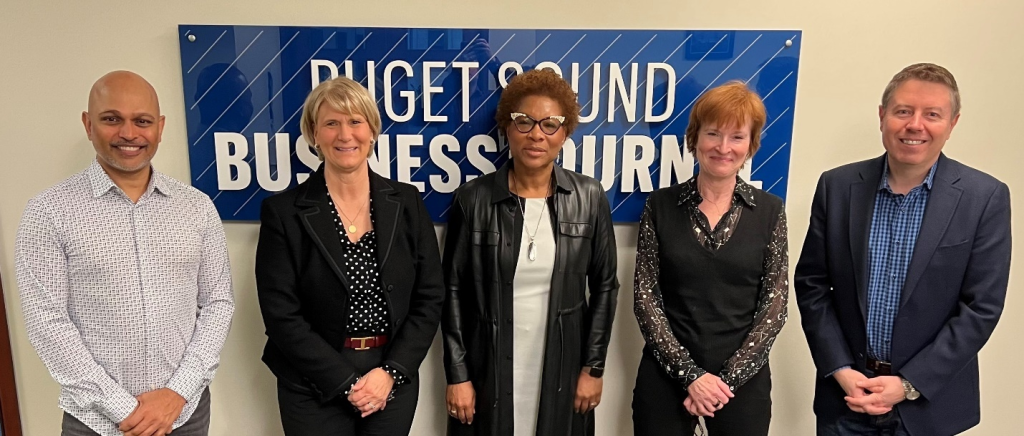
Regence convenes industry leaders to address the rising cost of care in Washington

Health care costs in Washington are skyrocketing, with families and employer groups struggling to pay for the care they need to stay healthy. Regence BlueShield recently partnered with the Puget Sound Business Journal to convene a panel of state health care leaders to explore why the cost of care keeps going up and what can be done to make care more affordable.
The Thought Leader Roundtable on health care affordability brought together Michael Cole, president of Regence BlueShield; Emily Brice, co-executive director of Northwest Health Law Advocates; Pam MacEwan, policy adviser for the Purchaser Business Group on Health; and Katie Martin, president and CEO of the Health Care Cost Institute.
Cole said health care costs have increased primarily because of record price increases from providers and record price increases in drugs, especially brand-name drugs. This is why it’s critical for Regence to stand up for members in contract negotiations with hospitals, to ensure that members don’t have to bear the burden of unsustainable increases in the cost of care, Cole said.
Controlling rising costs also requires all players in the health care industry to come together to reach solutions that may be difficult but that ultimately help consumers, Cole said.
“Everybody has to come in with an informed point of view from whatever part of the industry they’re from, and then be willing to listen and engage in areas they may not represent,” he said. “Whether it’s payers, providers, elected officials, regulators — everybody is going to come at it from a different lens. Active listening is really important to get us all to the right place.”
Katie Martin of the Health Care Cost Institute said, “the problem is big enough that everyone needs to chip in to solve it.”
“To the extent that industry sees opportunities to do better and bring costs down, they should absolutely do that,” she added. “There’s a probability that those efforts will be widely adopted or more warmly embraced, because they’re motivated by folks at the center. At the same time, elected officials, policymakers and regulators have a really important role to play because they represent the collective. They can communicate the priorities of the community, and in many cases also have the ability to make change at a scale that would be hard for any individual to do on their own.”
Read the full recap of the Thought Leader Roundtable in the Puget Sound Business Journal.